The Latest

The Confederate monument at Arlington National Cemetery: Vindication, Reconciliation, and Removal

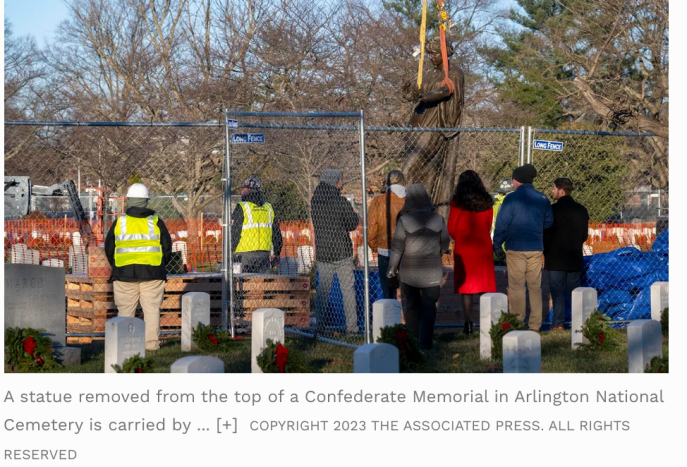
Today is a historic day.  The Confederate monument that has stood in Arlington National Cemetery for nearly 110 years is being removed.  While observers waited on the injunction against removal to be lifted, I wrote this piece (below) about its history, the narrative that swirls around this particular removal, and the real meaning of reconciliation.
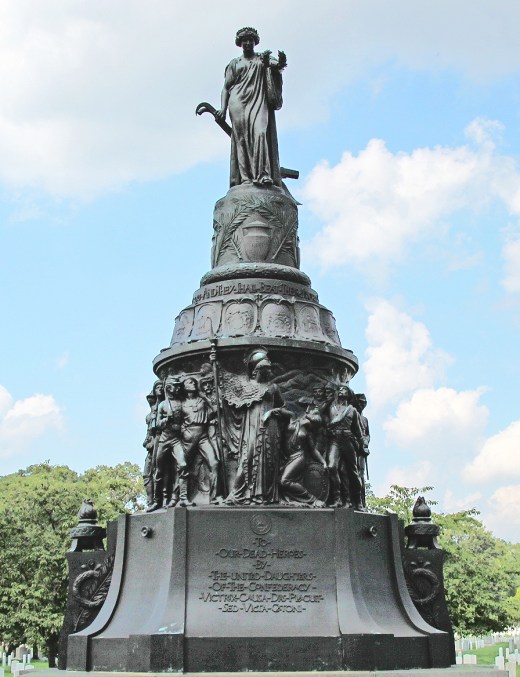
Confederate_Monument_-_S_face_tight_-_Arlington_National_Cemetery_-_2011

No sooner had workers begun the work of dismantling the Confederate monument at Arlington on Monday, than a federal judge issued a temporary restraining order halting the removal of one of the nation’s most prominent memorials to the Confederacy located on federal property.

Defend Arlington, the organization that brought the lawsuit against the Defense Department, claims that the removal had been “rushed,” even though the recommendation for removal came in August 2022 in the report filed by the Department’s Naming Commission. Still, it is the claim the Confederate memorial stands as a tribute to reconciliation where the historical narrative gets messy.

In his interview with the Washington Post, Scott Powell, a spokesman for Defend Arlington argued that the Confederate memorial simply represents “peace and reconciliation,” part of a narrative that’s been made in conservative circles as the time of removal has inched closer. On X, Matt Walsh repeated the message that the Arlington monument is a “Reconciliation Monument.” Both are a reference to sectional reconciliation between North and South fifty years after the Civil War.

What these defenders of removal do not have on their side are the facts of history.

Many of them point to President William McKinley’s 1898 speech in Atlanta that the federal government “should share . . . in the care of graves of Confederate soldiers.” This was not an invitation to build a Confederate memorial in Arlington National Cemetery but the United Daughters of the Confederacy (UDC) ran with it. In the fall of 1906, only a few months after Congress passed a law allowing the bodies of 267 Confederate soldiers buried on northern battlefields to be reinterred in a newly-designated section of the cemetery, local members of the UDC formed the Arlington Confederate Monument Association and engaged in a years-long fundraising campaign for the monument that is currently in litigation.

The Daughters were the first to suggest that the monument was a memorial of “peace and reconciliation,” which held a very different meaning in the early years of the twentieth century. The organization’s underlying goal since its formation in 1894 was not simply to honor their Confederate ancestors but to seek vindication for them and their cause. For white southerners vindication of the Confederacy became the clearest path to sectional reconciliation and a truly reunited country.

It meant that white northerners had to come around to white southerners’ way of thinking. Former Confederates weren’t “rebels” but “patriots.” And what did vindication look like? The Confederate monument in Arlington National Cemetery is a clear illustration.

Moses Ezekiel, the monument’s sculptor, called his design “New South.” Yet it is clearly a Lost Cause interpretation of the Old South and the Civil War and acts as a pro-Confederate textbook cast in bronze. Hilary Herbert, a former secretary of the U.S. Navy and an advisor to the Arlington Confederate Monument Association, made that clear when he referred to the statue as “history in bronze.” 

Many Daughters were loath to speak of reconciliation even at the time of the monument’s unveiling. They resented that their ancestors had ever been referred to as “traitors.” Had not the South, they asked, fought in defense of the Constitution? Of course, they meant the Tenth Amendment protecting states’ rights—the same amendment they believed gave them the right to enslave human beings.

The Arlington monument helped assuage those feelings of resentment, because it represented Confederate heroism and not its disloyalty.  There was also its placement on a landscape of national significance, which suggested to them that the North recognized the “truth” about the South. Marion Butler, the U.S. senator from North Carolina, explained it this way: “The whole spirit of the thing [referring to the monument] has been fostered by northerners, and they have helped the monument association in every way to bring its purpose to a grand success.”

What current politicians and conservatives are calling a “monument of reconciliation” or a “reconciliation monument” tells only part of the story. The terms of reconciliation were decided by former Confederates and the women who raised the money to build the Confederate monument in Arlington National Cemetery, which they presented as a “gift to the nation” in 1914.

And the terms were met. The nation’s cemetery became home to a memorial that vindicated the Confederate cause where it has remained for more than a century.

Its removal, however, will be the true reconciliation, because the Confederacy will no longer be venerated nor maintained by our federal government.


Screen Shot 2023-12-20 at 11.26.31 AM


When the Universe speaks, listen

Nearly four months ago,  I sat down to write a blog about stepping away from my latest book project on the Rhythm Club fire. The pressure of writing it had become unbearable. I was literally in tears. In truth, I was the only one putting on the pressure and it was making things worse. Listen to the universe.

In the summer of 2019 I believed that my research was complete (it wasn’t) to begin writing the book.  But that August I decided to write an op-ed on the two year anniversary of the Charlottesville “Unite the Right” rally and the ruse of organizers who suggested it was about protecting the monument to Confederate General Robert E. Lee. That decision led me in an entirely different direction than the one where I believed I was headed.  Listen to the universe.

After reading the op-ed, UNC Press asked me to consider writing a book on the history of Confederate monuments. I looked myself in the mirror and knew that I would do it but it meant shelving the book on the Rhythm Club.  The result was a new book, No Common Ground: Confederate Monuments and the Ongoing Fight for Racial Justice (2021). No regrets but there was still this nagging from the project on the shelf.

Four years and numerous talks, interviews, and essays on Confederate monuments later, I had yet to return to the Rhythm Club.  Yet wonderful things had happened during that time. Serendipitous things.  Things you wouldn’t believe unless I told you, so here goes.

In 2019 my mother, who lives in Greensboro, North Carolina, had gone to get a pedicure. Sitting next to her was a Black woman who was from . . . Natchez. They struck up a conversation and my mother told her about my book Goat Castle, which is set in the city. Mom also wrote down the woman’s name and number so I could reach out to her. She told me the woman’s name was Ora Frazier. Her last name was very familiar to me. The man who operated the Rhythm Club on the night of the fire was Ed Frazier. My gut told me there was a connection and indeed there was. Ora’s husband, now deceased, was Ed’s son. This led to an oral history with Mrs. Frazier and photos I’d never seen of her late husband’s father.  Listen to the universe.

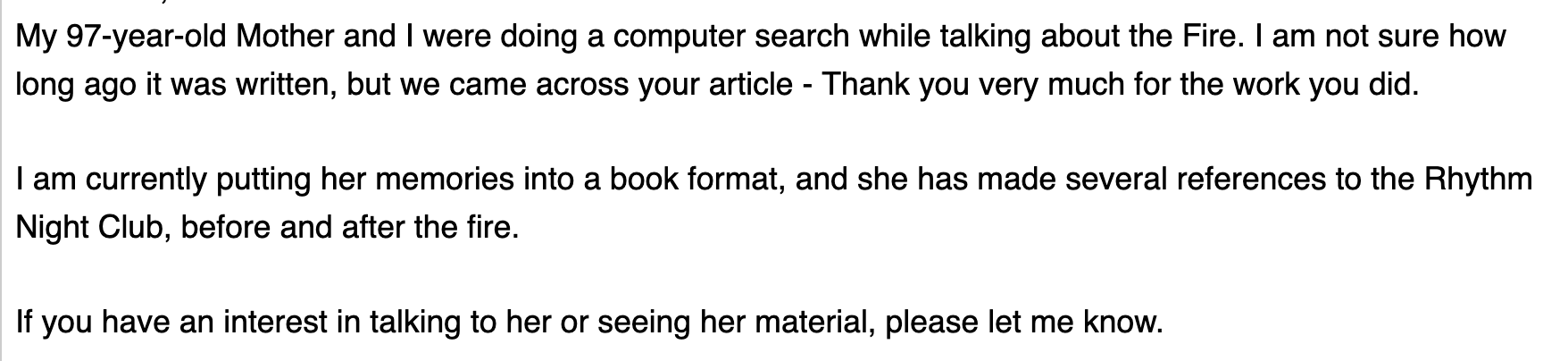
Then, in the spring of 2021, I received an email from a man who had read a 2018 blog entry I wrote about the fire for We’re History.  This is what it said:

letterfromRon

This woman, Alice Kastor Campbell, was sixteen when the fire consumed the Rhythm Club and took the lives of several of her friends. As of this writing, she is the last surviving witness to that terrible tragedy yet she is so much more than that. Her life represents an entree into the world of Black Natchez during the years when it was a thriving community.  And her son?  It turns out that Ron Hendrix, the man who wrote to me, is an ER doctor. . . wait for it . . . in Mint Hill, a community less than 30 minutes from my home in Charlotte. Listen to the universe.

Not only did Ron’s email lead to two interviews with Alice, I have developed a friendship with him and have since assisted him in getting his mother’s writings into print. And, in February 2024, I am traveling to San Antonio, Texas, for Alice’s 100th birthday celebration where I will meet her in person for the very first time.  Listen to the universe.

Between January and May of 2023, I felt I could return to the project. My goal was to write a book proposal and a sample chapter and then meet with book agents. All of that happened and yet I still shelved the project. The agents weren’t convinced but I kept trying to push ahead with the writing. The result was that I hit a brick wall and decided to shelve the project again. Listen to the universe

The last four months have been, as the academics like to say, generative. I took time to breathe and cut myself some slack for not writing about the Rhythm Club. Then, in October, I had a wonderful opportunity to join fellow scholars in New Mexico to workshop essays for a volume to be called “Contested Commemorations.” I was invited because of my work on monuments and memory and actually wrote something new. It was an invigorating experience amid the beauty of Taos where we were meeting. I stayed a few extra days in the state to see a friend from my Mississippi days who now lives in Santa Fe. That visit restored my spirit in ways I had not anticipated. I returned from that trip transformed both personally and professionally.  Listen to the universe.

Only a few days later, I received what is known as a “funding alert” email. I always look even when there’s nothing that is well suited to my project. But this day, there was an alert for a summer fellowship with the Black Metropolis Research Consortium (BMRC) in Chicago.  A significant part of my book project on the Rhythm Club is Chicago-based. Yes, the fire took place in Natchez. However, the jazz orchestra playing that evening was from Chicago. The Chicago Defender covered the story of the fire extensively. A group called the Natchez Social & Civic Club from Chicago raised money for the bronze plaque that memorializes the victims that sits on the Natchez bluff. Mississippi and Chicago are forever linked because of the Great Migration.  I realized that my research was not complete and so I applied for the fellowship. I have since applied for a second short-term fellowship with the Newberry Library, also in Chicago. Listen to the universe.

Regardless of what happens with these applications, the gift of time has allowed me to rethink what my book on the Rhythm Club fire might look like and to consider its meaning  beyond Natchez even though it most directly affected that community.  The universe is speaking. And, I’m listening.

Alice Kastor at 16.
Photo courtesy of Alice Kastor Campbell.

Bending Under the Weight of History

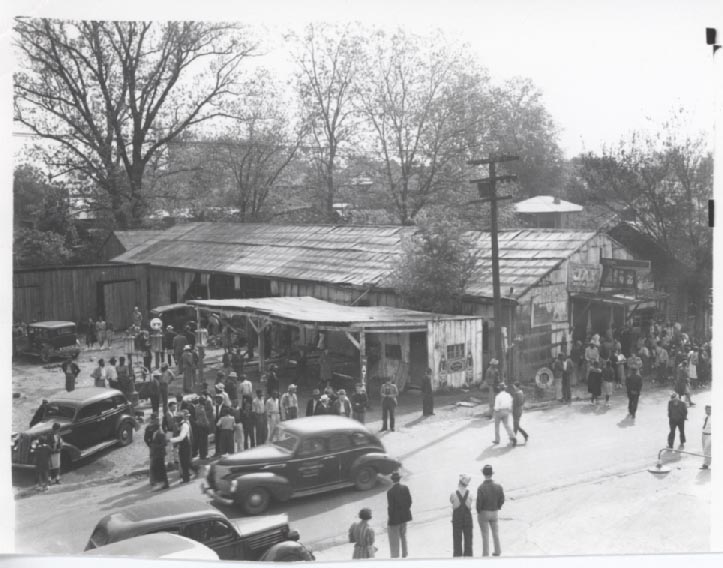
As many people know, I have been engaged for several years in researching a tragic event known as the Rhythm Club fire that took place in Natchez, Mississippi, on April 23, 1940.  That fire took the lives of 209 African Americans and when it occurred it was the deadliest club fire in the history of the United States. Yet most Americans have never heard of it. Even worse neither have many Mississippians, because it never made it into the state’s history books nor in the historical scholarship about the state. The closest we’ve come to any assessment is that by folklorist Vincent Joos whose thesis, and an article in the Southern Quarterly, investigated the memory of the fire through blues songs, photographs, and interviews.  This event captured my historian’s brain and I felt it was something worth investigating and writing about and I’ve spent weeks in various archives from Mississippi to Chicago to the National Archives in Washington, DC.

The Rhythm Club on the day after the fire, April 24, 1940. Photo courtesy of the Historic Natchez Foundation.

This past spring I worked diligently on a book proposal and wrote a sample chapter, the Chicago chapter, that explored the Great Migration of Mississippians, the jazz scene, and especially Walter Barnes–the maestro of a jazz orchestra he called his Royal Creolians. They were the group playing the Rhythm Club the night it burned. I then sent it to three agents, and while every single one of them told me how great the writing was, they all said they didn’t think they could sell the book. This was difficult to hear. As I told one of them, “you know, Black Mississippians get their asses handed to them on a daily basis in that state and this feels like one more dismissal of their lives.”   Later, after messaging with a good friend, I decided I would just write the book and figure this part out later.

Right now, I’m committed to writing a chapter focused on the memory of the fire for an edited volume. It’s different from what Joos wrote, although his analysis of the blues are important, as are his interviews.  So, I’ve been slogging away at that. And when I say “slog” I mean it.  It’s like wading through ankle deep mud while carrying a bag of bricks. It’s heavy and it’s difficult. And it’s exhausting.  I’ve kept at it because of the responsibility I feel to the people I’m writing about.

But it has come at the expense of my own self care and I’ve hit a breaking point.  It’s been coming for awhile.

The research and writing for my last two books were hard on me emotionally, because both were focused on difficult history. Goat Castle (2018) was essentially a story of racial injustice.  There were times while writing about the racial trauma of Emily Burns, the domestic who was unjustly convicted and sent to Parchman prison as an accomplice to murder,  that I began to cry. I’d have to stop and go for walks to shake it off. It’s referred to as “secondary trauma” and scholars of slavery and racial violence understand and grapple with these feelings far more than I have, but I am in sympathy with them for the hard work they do.

Then in 2019, I was called on by UNC Press to write what became No Common Ground (2021).  I did so with some hesitation, because not only had I written several op eds to lend some context to the national conversation about Confederate monuments, I had been on the road for two years speaking about the issue, trying to help people to understand the ugly history of white supremacy, racial injustice, and even racial violence that accompanied these seemingly static objects. As I was writing the pandemic hit, as did the isolation. Having to focus on this “hard history,” as the podcast of the same name calls it, was a difficult task and I melted down as I neared the finish line for that book.

Two years after its publication, my editor’s promise that No Common Ground would be the last word on the subject rings hollow, because I’m still being asked to speak and write about the damned monuments, as I call them.  It is a burden, but one I’ve been willing to carry. I do so, because I believe it’s important to educate people about the topic and for them to also hear from a white southerner who speaks honestly about their meaning.

All the while, I have tried valiantly to move on to the book about the Rhythm Club fire, to explain why it was important to the Black community nationally, but especially to those who were so deeply affected by it. I am angry about its erasure from history, as we all should be.

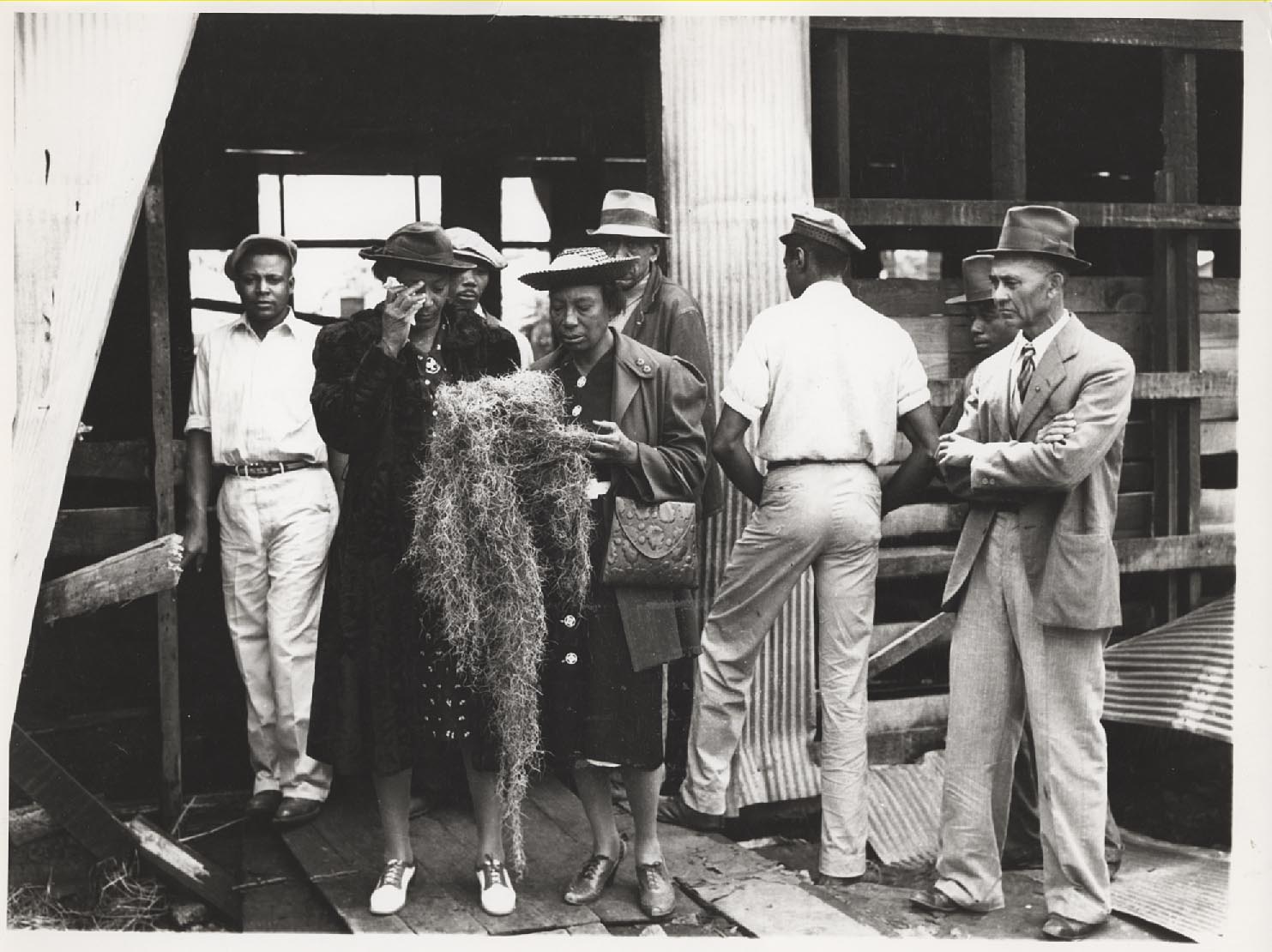
Rhythm Club, woman with Spanish moss
Unidentified woman holding Spanish moss. The fire caught on the moss, which had been used as decoration inside of the club. April 24, 1940, Courtesy of Historic Natchez Foundation.

Yet this, too, is hard history.  And it is rife with trauma. I think it is telling that of the two chapters I’ve written, one examines the  history prior to the fire and the other examines the memory of the fire. I was not, and still am not, ready to write about the suffering of so many young people.

I have personally struggled to even be able to say this out loud, because I feel like I am failing so many people.  My mother asked me “what about failing you?”  It’s the kind of question that can stop you in your tracks. I realize that if I don’t take care of me, I will never be able to do the topic justice.

So, I’m stepping away from it for now and I’m not going to make predictions about if or when I’ll return to it. That’s just more stress that I simply do not need. I hope that my friends and those who have followed this journey will understand.

The Fruit of Preparation and Opportunity

What a week! When I wrote my book No Common Ground: Confederate Monuments and the Ongoing Fight for Racial Justice (UNC Press, 2021) I could not have anticipated the opportunities that have come my way–from speaking engagements to being a talking head in documentaries to invitations to contribute essays in other books.  Sometimes I think I’m lucky, but I also think of luck in the way that Oprah does. “I believe luck is preparation meeting opportunity.”

A year or so ago, I was presented with opportunities–for which I’ve prepared most of my adult life–and they all bore fruit this past week.

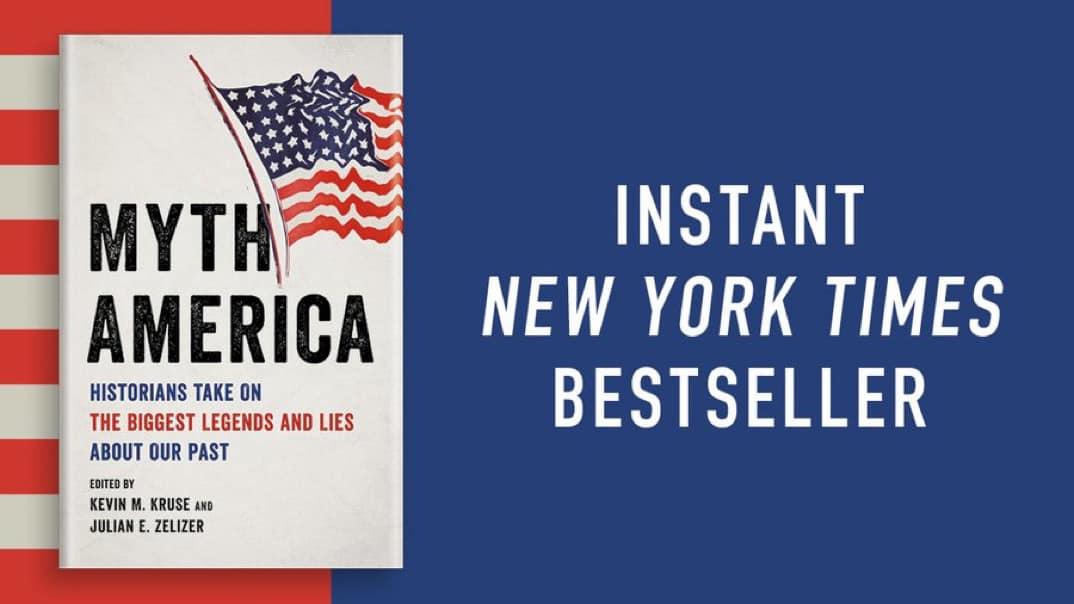
325305809_1414362125968434_1700213639048886674_nThe first was to contribute an essay to a book about myths in American history, edited by Princeton historians Kevin Kruse and Julian Zelizer. I wrote about Confederate monuments as an expression of the Lost Cause myth.  This past week that book, Myth America: Historians Take on the Biggest Legends and Lies About Our Past, became an instant best seller on the New York Times bestseller list for nonfiction books, coming in at #8.
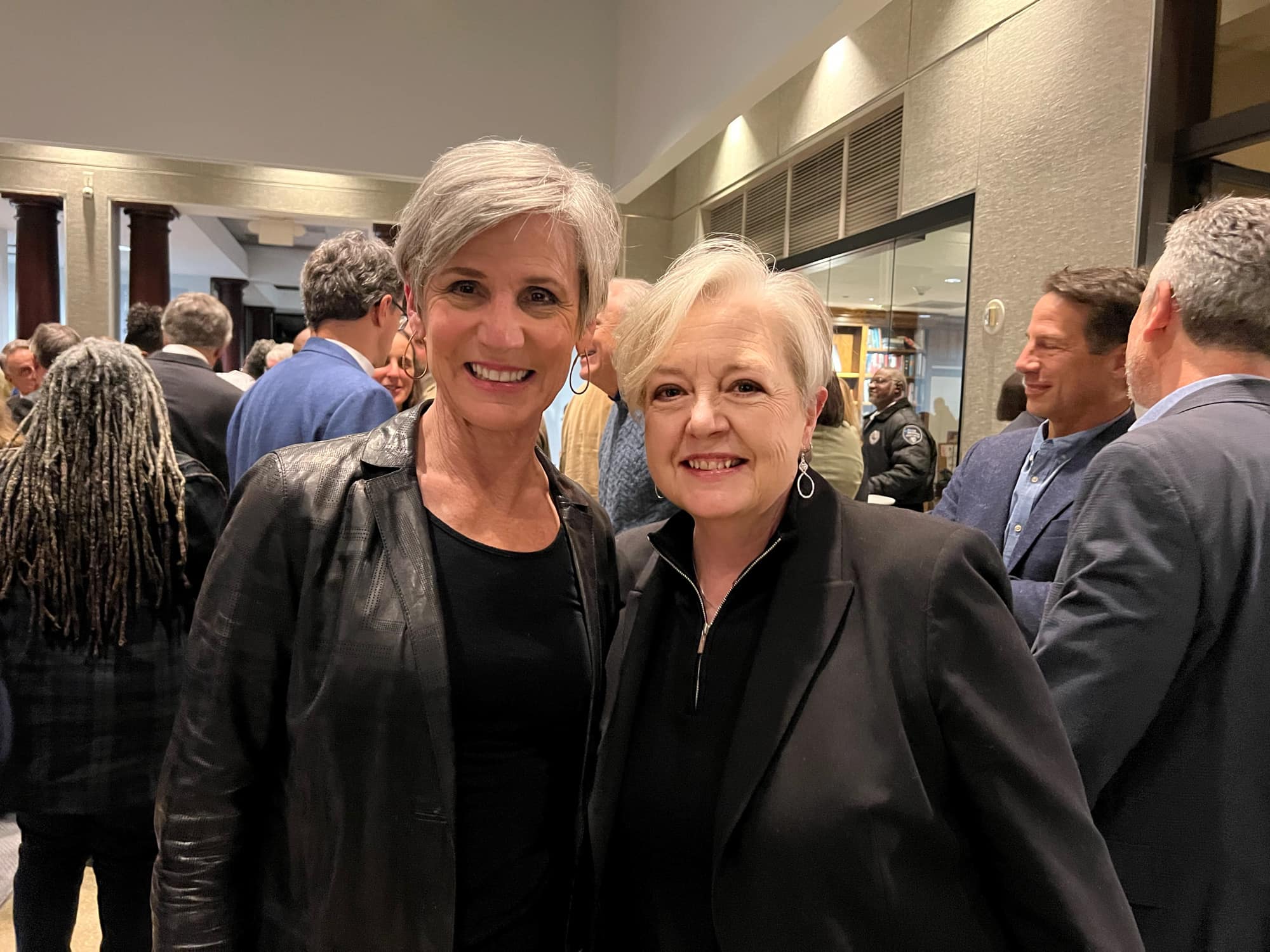
The second was to be interviewed for a documentary on Stone Mountain that was being 324560266_503042738633123_9033108230684294788_nproduced by the Atlanta History Center (AHC) and its VP of Digital Storytelling, Kristian Weatherspoon.  This past week I got to attend the film’s premiere at the AHC. It was such a wonderful event and a real celebration of the work that public history institutions can do, plus I got to meet a personal heroine of mine, Sally Yates, the former United States Deputy Attorney General and Acting Attorney General who stood up to former President Trump’s so-called “Muslim ban.” She was dismissed for doing so, but I regarded it as an act of moral courage. We need more of that in today’s world.
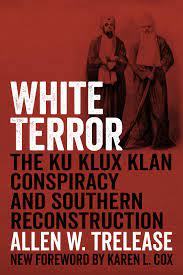
White TerrorThen last, but not least, I just received my copy of the re-released book White Terror: The Ku Klux Klan Conspiracy and Southern Reconstruction by Allen W. Trelease.  It was a book I campaigned to have placed back in print, because it remains relative to historical discussions about Reconstruction but also to our contemporary understanding of domestic terrorism. It was an honor for me to write the foreword since Dr. Trelease was a professor and mentor while I was a student in the master’s program in history at UNC Greensboro.

I’ve worked hard for what I’ve accomplished, but sometimes it feels like an embarrassment of riches. This week was one of those weeks.


The Racism of Confederate Monuments Extends to Voter Suppression

Over the past few weeks, Americans have watched as Black Lives Matter protests have turned on Confederate monuments, vandalizing them, tearing them down, spraying them with graffiti with messages to end police brutality or to call out the racism that is tearing our country apart.

As a result, several municipalities across the South have begun to take local action to remove their monuments, often located on courthouse lawns or along public thoroughfares. Doing so means to defy state laws, some of which were passed in the aftermath of the Charleston Massacre of nine parishioners inside Emmanuel AME Church five years ago.

Today voter suppression in several states, made worse by gerrymandered districts like in my home state of North Carolina, makes it difficult to near impossible to elect officials who will change laws, including those intended to preserve Confederate monuments. In fact, the history of Confederate monuments is tied directly to the disenfranchisement of black voters and has been since the 1890s.

When the monument to Robert E. Lee was unveiled in Richmond in 1890, African Americans in that city recognized it as a symbol of their own oppression and its links to suppressing their right to vote.  Barely a week after unveiling of the Lee Monument, John Mitchell, Jr. the editor of the black newspaper the Richmond Planet, penned an editorial in which he warned readers that the rights blacks had won during Reconstruction were being rolled back, especially the right to vote. “No species of political crimes has been worse than that which wiped the names of thousands of bona-fide Colored Republican voters from the Registration books of this state,” Mitchell wrote. He claimed, rightly, that refusing to allow black men to vote was a “direct violation of the law,” and blamed state officials sworn to uphold the U.S. Constitution for illegally scrubbing the names of men from voter rolls, marking them “dead” or having moved to another state, when neither was true. 

Mitchell’s words were prophetic as he identified what was essentially a backlash against black progress.

In the decade following the Lee Monument’s unveiling, one southern state after another passed laws disenfranchising black men, a right that was guaranteed by the Fifteenth Amendment. The elimination of black voters, not only by law but through violent white supremacy, and the creation of Jim Crow legislation that limited black freedom, all occurred during the very same years that the hundreds of Confederate monuments now at issue were built across the South.  And black southerners did not have a say in the matter, because their rights as citizens had been obliterated. Even in towns where they represented the majority of the population, they could not vote to prevent them from being built in the center of towns where they lived, they could not petition to have them removed, and they could not protest them publicly out of fear of reprisal, although they found ways of doing so out of the view of southern whites.

Following the passage of the Civil Rights Act of 1964, and especially the Voting Rights Act of 1965, black southerners not only voted, but elected people to office who looked like them. Local city councils increasingly had black representation and over the course of the next few decades African Americans throughout the region challenged the existence of Confederate symbols on the grounds of local and state government, which were supposed to be democratic public spaces that represented all citizens.

But in the 1990s, as in the 1890s, Republicans found another way to constrict black political power via majority/minority districts. This form of gerrymandering, sometimes called affirmative gerrymandering, did not violate Voting Rights Act regulations. Rather, it consolidated the minority vote, limiting a black majority to one district. As political scientist Angie Maxwell explains, while these new lines ensured minority representation, “it bleached the other districts white, allowing the GOP to pick up seats fast in the South.” The result in 1994 was the Republican takeover of the House.

This model of Republican-favored gerrymandering grew worse in the South in the early twentieth-first century, and its implementation not only guaranteed more GOP seats in Congress, it led to a similar plan that ensured GOP majorities at the state level. And these are the very state legislatures that passed monument laws designed to preserve Confederate monuments in publicly owned spaces.

The gutting of the Voting Rights Act in 2013 in the context of Confederate monument removal is critical to our understanding of this moment of protests.  By suppressing the rights of black voters, as well as white voters who support this movement, GOP-led state legislatures have not only prevented these voters from exercising their rights as citizens, they have usurped local control to remove monuments legally. In essence, they have left no other options for redressing this issue than to take to the streets to demonstrate their frustration.

Still, there have been signs in the last few weeks that there are cracks in the system, as local communities across the South have begun the process of removing their monuments, even in defiance of state laws. In Alabama, the cities of Birmingham, Huntsville, and Mobile have taken action to remove their monuments and accept the $25,000 fine the state imposes for such action.  In North Carolina, the law preventing removal of “objects of remembrance” is so imprecise that the towns of Asheville, Rocky Mount, and Salisbury are testing its limits by voting to remove their monuments.

Monuments are ultimately local objects and what becomes of them will be determined by the local communities in which they reside. And while it appears that the tide has turned, as several southern cities and towns have voted or are voting to remove monuments, the state laws remain a barrier to removal.

There also exists a very real concern that once GOP-led southern legislatures return to session, Republicans will close any existing loopholes in monument legislation, which will represent yet another backlash to progress. And once again, there will be no legal redress. And given voter suppression, it removes the possibility of electing officials to amend laws that allow local communities to decide the fate of Confederate monuments.

Under those circumstances, the cycle of protest will likely begin again.