When the Universe speaks, listen

Nearly four months ago,  I sat down to write a blog about stepping away from my latest book project on the Rhythm Club fire. The pressure of writing it had become unbearable. I was literally in tears. In truth, I was the only one putting on the pressure and it was making things worse. Listen to the universe.

In the summer of 2019 I believed that my research was complete (it wasn’t) to begin writing the book.  But that August I decided to write an op-ed on the two year anniversary of the Charlottesville “Unite the Right” rally and the ruse of organizers who suggested it was about protecting the monument to Confederate General Robert E. Lee. That decision led me in an entirely different direction than the one where I believed I was headed.  Listen to the universe.

After reading the op-ed, UNC Press asked me to consider writing a book on the history of Confederate monuments. I looked myself in the mirror and knew that I would do it but it meant shelving the book on the Rhythm Club.  The result was a new book, No Common Ground: Confederate Monuments and the Ongoing Fight for Racial Justice (2021). No regrets but there was still this nagging from the project on the shelf.

Four years and numerous talks, interviews, and essays on Confederate monuments later, I had yet to return to the Rhythm Club.  Yet wonderful things had happened during that time. Serendipitous things.  Things you wouldn’t believe unless I told you, so here goes.

In 2019 my mother, who lives in Greensboro, North Carolina, had gone to get a pedicure. Sitting next to her was a Black woman who was from . . . Natchez. They struck up a conversation and my mother told her about my book Goat Castle, which is set in the city. Mom also wrote down the woman’s name and number so I could reach out to her. She told me the woman’s name was Ora Frazier. Her last name was very familiar to me. The man who operated the Rhythm Club on the night of the fire was Ed Frazier. My gut told me there was a connection and indeed there was. Ora’s husband, now deceased, was Ed’s son. This led to an oral history with Mrs. Frazier and photos I’d never seen of her late husband’s father.  Listen to the universe.

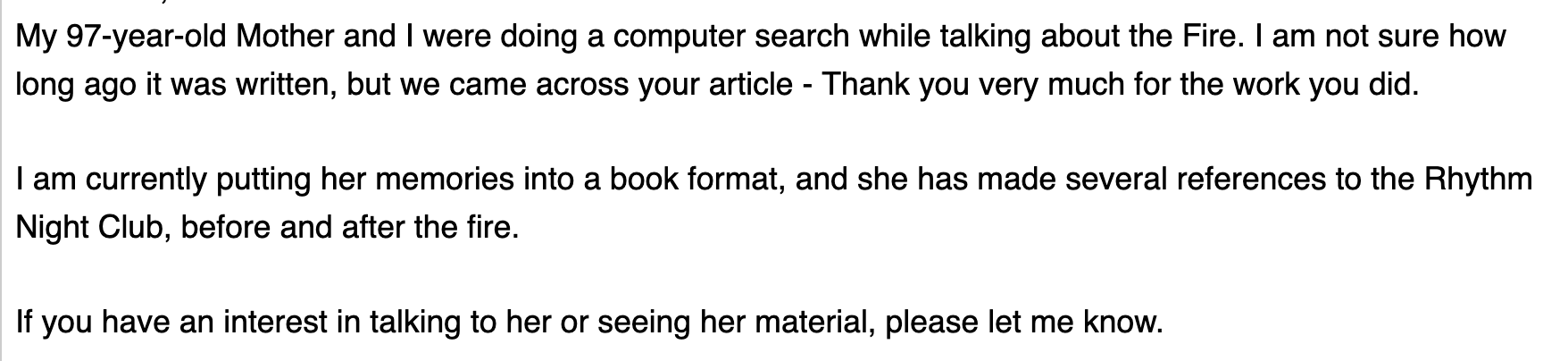
Then, in the spring of 2021, I received an email from a man who had read a 2018 blog entry I wrote about the fire for We’re History.  This is what it said:
letterfromRon

This woman, Alice Kastor Campbell, was sixteen when the fire consumed the Rhythm Club and took the lives of several of her friends. As of this writing, she is the last surviving witness to that terrible tragedy yet she is so much more than that. Her life represents an entree into the world of Black Natchez during the years when it was a thriving community.  And her son?  It turns out that Ron Hendrix, the man who wrote to me, is an ER doctor. . . wait for it . . . in Mint Hill, a community less than 30 minutes from my home in Charlotte. Listen to the universe.

Not only did Ron’s email lead to two interviews with Alice, I have developed a friendship with him and have since assisted him in getting his mother’s writings into print. And, in February 2024, I am traveling to San Antonio, Texas, for Alice’s 100th birthday celebration where I will meet her in person for the very first time.  Listen to the universe.

Between January and May of 2023, I felt I could return to the project. My goal was to write a book proposal and a sample chapter and then meet with book agents. All of that happened and yet I still shelved the project. The agents weren’t convinced but I kept trying to push ahead with the writing. The result was that I hit a brick wall and decided to shelve the project again. Listen to the universe

The last four months have been, as the academics like to say, generative. I took time to breathe and cut myself some slack for not writing about the Rhythm Club. Then, in October, I had a wonderful opportunity to join fellow scholars in New Mexico to workshop essays for a volume to be called “Contested Commemorations.” I was invited because of my work on monuments and memory and actually wrote something new. It was an invigorating experience amid the beauty of Taos where we were meeting. I stayed a few extra days in the state to see a friend from my Mississippi days who now lives in Santa Fe. That visit restored my spirit in ways I had not anticipated. I returned from that trip transformed both personally and professionally.  Listen to the universe.

Only a few days later, I received what is known as a “funding alert” email. I always look even when there’s nothing that is well suited to my project. But this day, there was an alert for a summer fellowship with the Black Metropolis Research Consortium (BMRC) in Chicago.  A significant part of my book project on the Rhythm Club is Chicago-based. Yes, the fire took place in Natchez. However, the jazz orchestra playing that evening was from Chicago. The Chicago Defender covered the story of the fire extensively. A group called the Natchez Social & Civic Club from Chicago raised money for the bronze plaque that memorializes the victims that sits on the Natchez bluff. Mississippi and Chicago are forever linked because of the Great Migration.  I realized that my research was not complete and so I applied for the fellowship. I have since applied for a second short-term fellowship with the Newberry Library, also in Chicago. Listen to the universe.

Regardless of what happens with these applications, the gift of time has allowed me to rethink what my book on the Rhythm Club fire might look like and to consider its meaning  beyond Natchez even though it most directly affected that community.  The universe is speaking. And, I’m listening.

Alice Kastor at 16.
Photo courtesy of Alice Kastor Campbell.
Bending Under the Weight of History

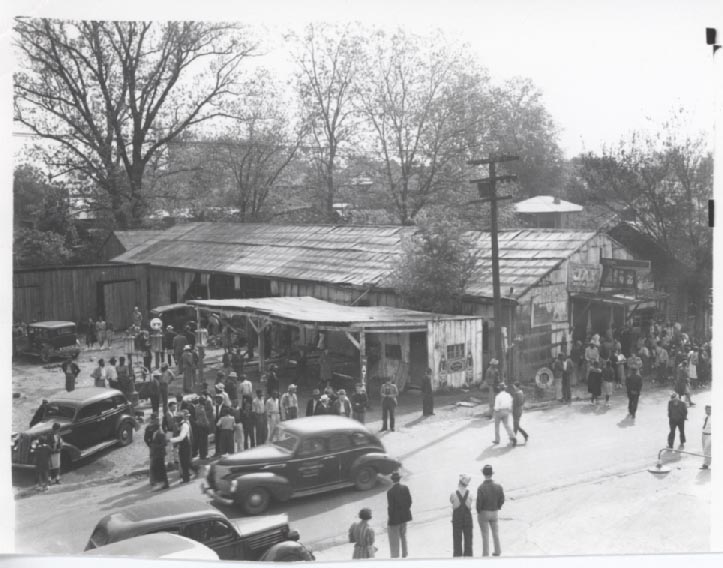
As many people know, I have been engaged for several years in researching a tragic event known as the Rhythm Club fire that took place in Natchez, Mississippi, on April 23, 1940.  That fire took the lives of 209 African Americans and when it occurred it was the deadliest club fire in the history of the United States. Yet most Americans have never heard of it. Even worse neither have many Mississippians, because it never made it into the state’s history books nor in the historical scholarship about the state. The closest we’ve come to any assessment is that by folklorist Vincent Joos whose thesis, and an article in the Southern Quarterly, investigated the memory of the fire through blues songs, photographs, and interviews.  This event captured my historian’s brain and I felt it was something worth investigating and writing about and I’ve spent weeks in various archives from Mississippi to Chicago to the National Archives in Washington, DC.

The Rhythm Club on the day after the fire, April 24, 1940. Photo courtesy of the Historic Natchez Foundation.

This past spring I worked diligently on a book proposal and wrote a sample chapter, the Chicago chapter, that explored the Great Migration of Mississippians, the jazz scene, and especially Walter Barnes–the maestro of a jazz orchestra he called his Royal Creolians. They were the group playing the Rhythm Club the night it burned. I then sent it to three agents, and while every single one of them told me how great the writing was, they all said they didn’t think they could sell the book. This was difficult to hear. As I told one of them, “you know, Black Mississippians get their asses handed to them on a daily basis in that state and this feels like one more dismissal of their lives.”   Later, after messaging with a good friend, I decided I would just write the book and figure this part out later.

Right now, I’m committed to writing a chapter focused on the memory of the fire for an edited volume. It’s different from what Joos wrote, although his analysis of the blues are important, as are his interviews.  So, I’ve been slogging away at that. And when I say “slog” I mean it.  It’s like wading through ankle deep mud while carrying a bag of bricks. It’s heavy and it’s difficult. And it’s exhausting.  I’ve kept at it because of the responsibility I feel to the people I’m writing about.

But it has come at the expense of my own self care and I’ve hit a breaking point.  It’s been coming for awhile.

The research and writing for my last two books were hard on me emotionally, because both were focused on difficult history. Goat Castle (2018) was essentially a story of racial injustice.  There were times while writing about the racial trauma of Emily Burns, the domestic who was unjustly convicted and sent to Parchman prison as an accomplice to murder,  that I began to cry. I’d have to stop and go for walks to shake it off. It’s referred to as “secondary trauma” and scholars of slavery and racial violence understand and grapple with these feelings far more than I have, but I am in sympathy with them for the hard work they do.

Then in 2019, I was called on by UNC Press to write what became No Common Ground (2021).  I did so with some hesitation, because not only had I written several op eds to lend some context to the national conversation about Confederate monuments, I had been on the road for two years speaking about the issue, trying to help people to understand the ugly history of white supremacy, racial injustice, and even racial violence that accompanied these seemingly static objects. As I was writing the pandemic hit, as did the isolation. Having to focus on this “hard history,” as the podcast of the same name calls it, was a difficult task and I melted down as I neared the finish line for that book.

Two years after its publication, my editor’s promise that No Common Ground would be the last word on the subject rings hollow, because I’m still being asked to speak and write about the damned monuments, as I call them.  It is a burden, but one I’ve been willing to carry. I do so, because I believe it’s important to educate people about the topic and for them to also hear from a white southerner who speaks honestly about their meaning.

All the while, I have tried valiantly to move on to the book about the Rhythm Club fire, to explain why it was important to the Black community nationally, but especially to those who were so deeply affected by it. I am angry about its erasure from history, as we all should be.

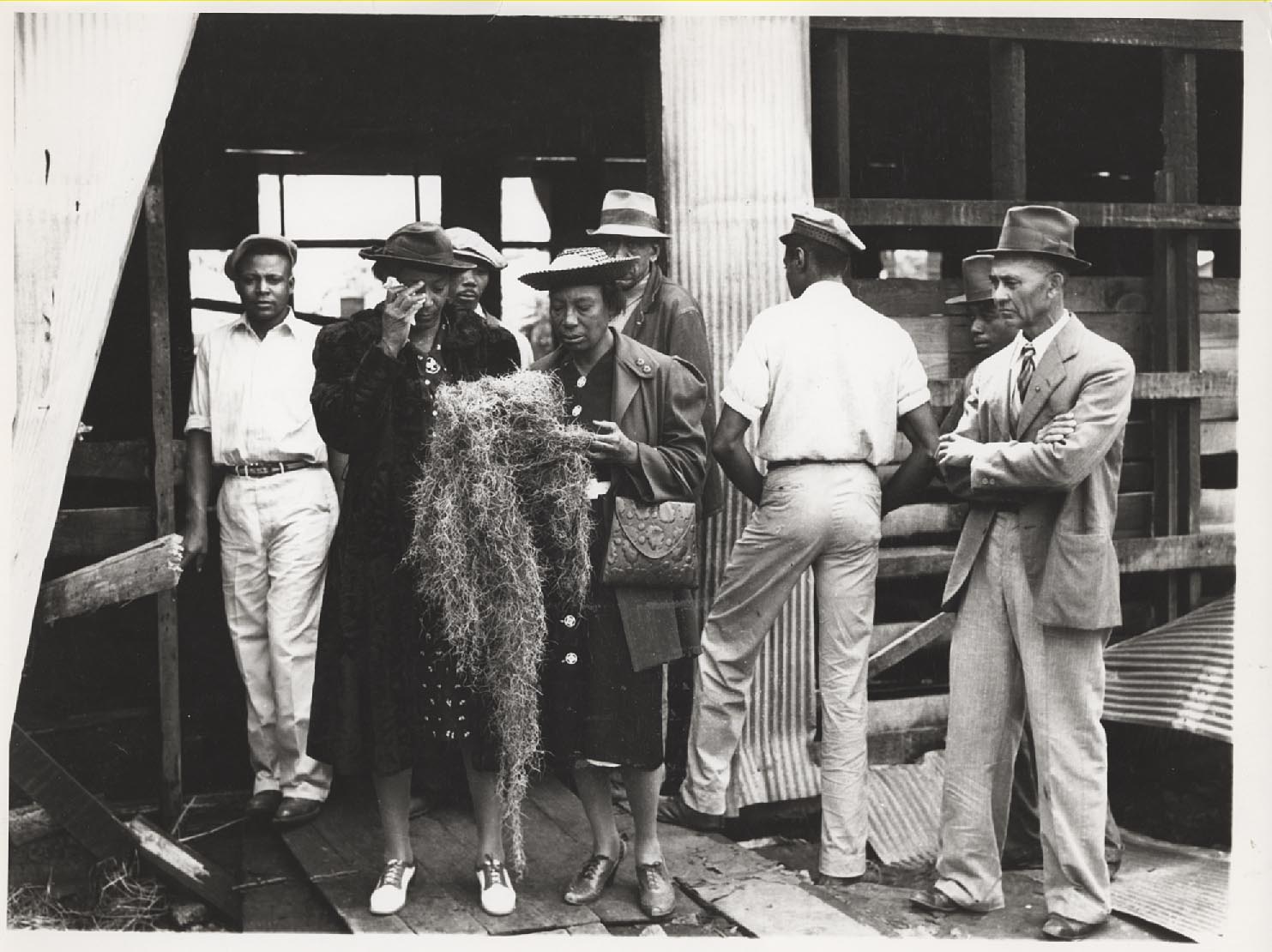
Rhythm Club, woman with Spanish moss
Unidentified woman holding Spanish moss. The fire caught on the moss, which had been used as decoration inside of the club. April 24, 1940, Courtesy of Historic Natchez Foundation.

Yet this, too, is hard history.  And it is rife with trauma. I think it is telling that of the two chapters I’ve written, one examines the  history prior to the fire and the other examines the memory of the fire. I was not, and still am not, ready to write about the suffering of so many young people.

I have personally struggled to even be able to say this out loud, because I feel like I am failing so many people.  My mother asked me “what about failing you?”  It’s the kind of question that can stop you in your tracks. I realize that if I don’t take care of me, I will never be able to do the topic justice.

So, I’m stepping away from it for now and I’m not going to make predictions about if or when I’ll return to it. That’s just more stress that I simply do not need. I hope that my friends and those who have followed this journey will understand.

Metaphor for writing a book

Since embarking on my new book project on the Rhythm Club Fire, I’ve gotten questions about why I’d want to work on something so depressing, which is a blog for another day, but mainly they’ve been about what I’ll say.  At this point, I cannot answer that question.  None of us who has authored a book can, especially when we are so early in the process. So, I’ve come up with a metaphor that I think works, and one which people who’ve never written a book can understand.

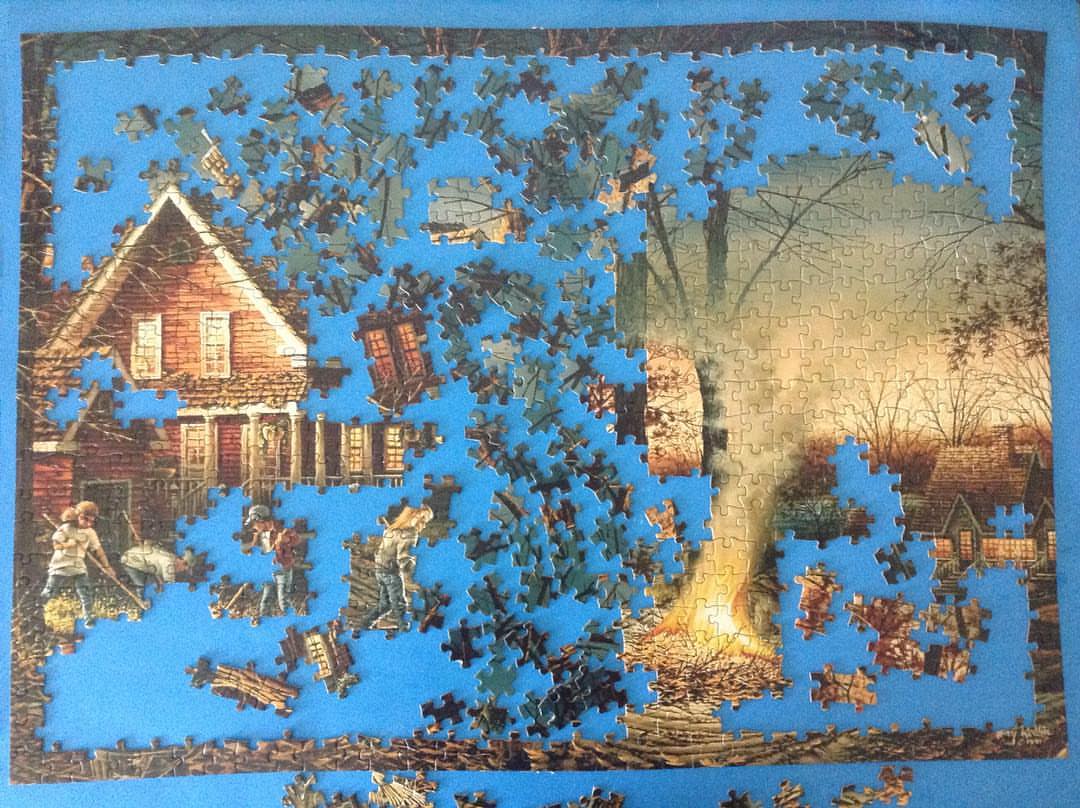
“It’s like putting together a 500-piece puzzle,” I answer.

At the beginning is the idea, and all of those pieces of evidence.

Puzzle Pieces GIF - Find & Share on GIPHY

In the early stages, you begin pulling together ideas that form the basic framework for the book.

So, the basic outlines of the story are . . .

Further into the project, some of the ideas begin to take shape.

largeportionspuzzle
This much is very clear.

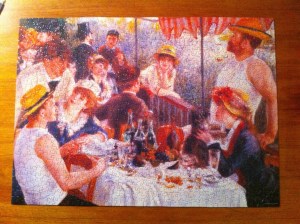
Eventually, the day comes when you have figured it out and hooray!

My book is almost as good as a Renoir painting! Not quite, but . . .

As with any puzzle, it takes time and patience, but part of the joy is in the process–figuring out where the pieces fit. When it’s complete there’s a moment of euphoria, but it is fleeting.

Now what?  Time to start a new puzzle.

What’s Happening!!

The cast of What’s Happening!!

As a pre-teen in the ’70s, I was a fan of the show “What’s Happening” with Roger, Dee, their Momma, Rerun, and Dwayne. And let’s not forget Shirley. So, even though I’m writing about what’s happening with me as an author, I can’t help but think of that show.

I’ve got a few speaking/book engagements coming up, too.

University of Michigan, March 12th
Tennessee Williams Festival, March 25th
Univ. of Louisiana-Lafayette, April 10-11th
Seminary Co-op in Chicago, May 3rd
DePaul University, May 4th

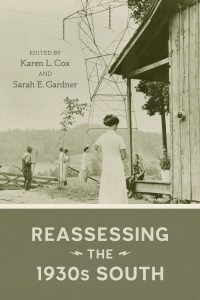
Then, in May, Louisiana University Press will release the volume Reassessing the 1930s South, which I co-edited with Sarah Gardner, a professor of history at Mercer University.  The volume is truly interdisciplinary as it brings together scholars of history, literature, and American Studies.

This summer, I’ll return to Natchez for local research on my newest project, which will examine the Rhythm Club Fire that took the lives of 209 African Americans on April 23, 1940.  It was one of the deadliest fires in the history of the U.S., outranking the Triangle Shirtwaist Fire in New York in 1911.